
Urgent Care for Dogs and Cats in Surrey
Urgent care means being seen today, because something is wrong and it will not keep until next week. For dogs and cats in Surrey that means same-day appointment capacity held open for pets who cannot wait for a routine visit. We are open Monday to Saturday from 8:00 AM to 10:00 PM, and Sunday from 9:00 AM to 6:00 PM, and urgent cases are triaged as they arrive during those hours. Call ahead on (604) 501-0077 if you can, because it lets us prepare before you walk through the door.
Outside of our clinic hours, we encourage you to contact a nearby 24-hour veterinary facility for urgent care.
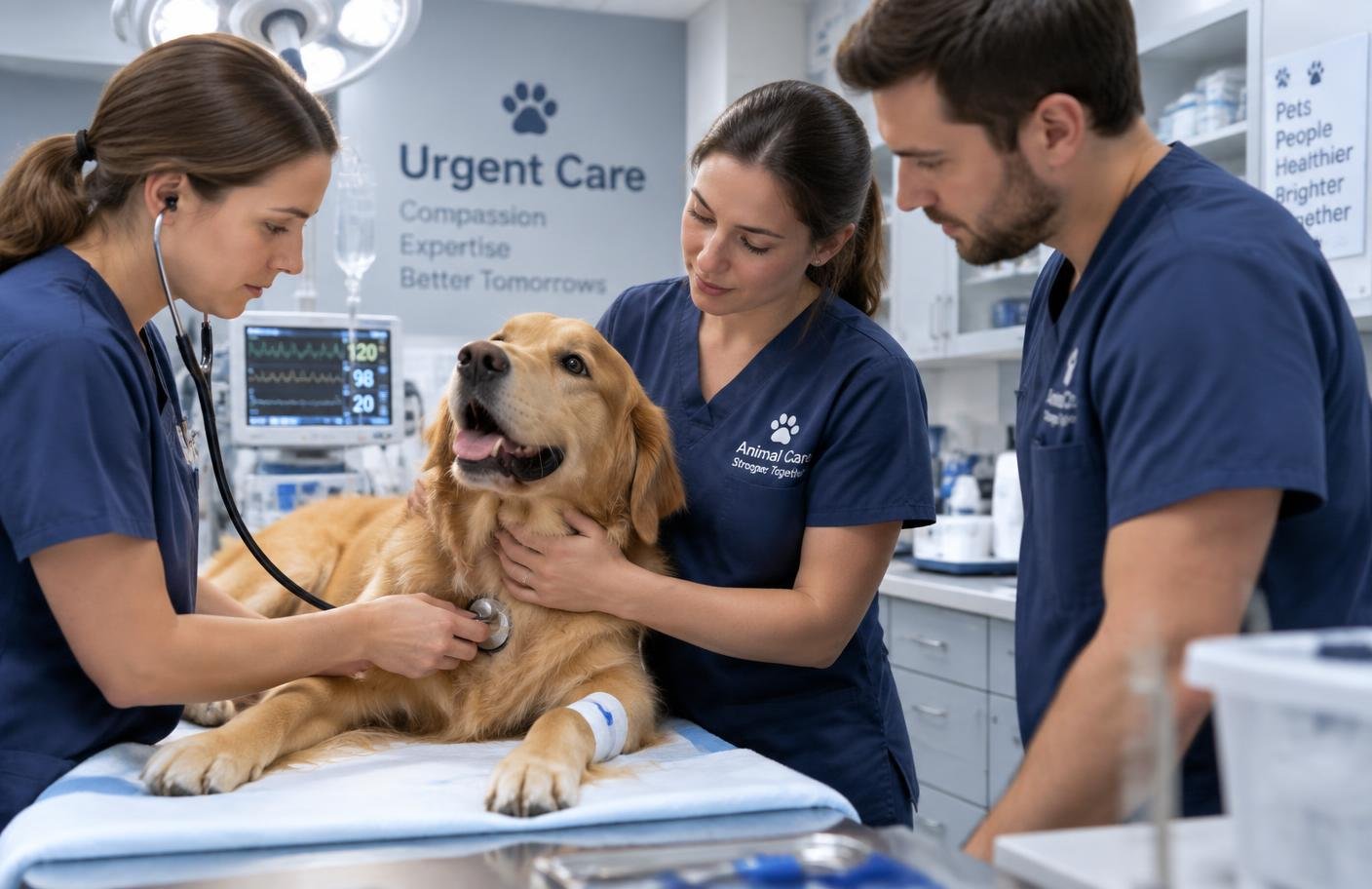
Veterinary urgent care is same-day attention for a pet whose problem cannot wait for a routine appointment but who is being seen during a clinic’s open hours. Cases are triaged on arrival by severity rather than order of booking. Common reasons include breathing changes, repeated vomiting, straining to urinate, wounds, and suspected toxin ingestion.
Signs Your Pet Needs Urgent Care in Surrey
Some situations should not wait until tomorrow. Call us straight away if you notice laboured or noisy breathing, collapse, seizures, uncontrolled bleeding, a wound or laceration, repeated vomiting or diarrhoea, straining to urinate with little or nothing produced, sudden severe limping, a swollen and tight abdomen, or any suspicion that your pet has eaten something it should not have.
A male cat straining in the litter box is one of the most time-critical situations we see. Urinary blockage can become life-threatening within hours, and it is frequently mistaken at home for constipation.
How Triage Works in Surrey
When you arrive, a team member assesses your pet quickly to judge how urgent the situation is. That assessment, not arrival order, determines who is seen first.
Why you might wait
If a patient arrives behind you in a more critical state, they will be seen before you. We know that is frustrating when your own animal is unwell, and we would ask the same consideration if the positions were reversed.
What happens next
Once your pet is stabilised and comfortable, we discuss what we have found, what it is likely to mean, and what the choices are before anything further goes ahead. Nothing beyond stabilising your pet happens without your agreement, and you will have an estimate in writing first.
Suspected Poisoning and Toxin Ingestion in Surrey
If you believe your pet has eaten something harmful, call immediately rather than waiting for symptoms. Timing changes outcomes considerably, and the window is often shorter than people expect.
Bring the packaging or a photograph of whatever was eaten if you have it. Knowing the exact substance and a rough quantity lets us act faster. Please do not attempt anything at home first, including making your pet vomit, unless a veterinarian has specifically told you to.
The things we see most often are not unusual. Chocolate, grapes and raisins, xylitol in sugar-free gum, onions and garlic, rat and slug bait, antifreeze, lilies in cats, cannabis, and human pain relief tablets account for most calls. Several are dangerous in very small amounts, and some produce no symptoms for a day or more while damage is already underway.
What We Can Handle During Clinic Hours in Surrey
We have in-house laboratory equipment, digital radiography, and ultrasound on site, so a great deal can be assessed and resolved during the same visit rather than across several days. Wound care, foreign body cases, allergic reactions, heatstroke, and acute gastrointestinal upsets are all handled here routinely.
Where a case needs overnight hospitalisation or a procedure beyond what we provide, we stabilise your pet first and then coordinate referral to our specialist referral partners with the full history attached.
Being honest about that boundary matters. A patient needing continuous monitoring through the night is better off somewhere staffed through the night, and we would rather say so at eight in the evening than nine. What we can do is get your pet stable, the urgent assessment done, the imaging and bloodwork in hand, and make sure whoever takes over is not starting from nothing.
Breathing Difficulty and Collapse in Surrey
Anything affecting breathing goes to the front of the queue. Call us and come straight in if you see laboured or noisy breathing, breathing with an open mouth in a cat, a blue or grey tinge to the gums or tongue, or a stretched-out neck and elbows held away from the body.
Collapse and fainting are equally urgent, even where the animal seems normal again within a minute. A dog that drops and recovers may have a heart rhythm problem, internal bleeding, or a drop in blood sugar, and the fact that it looks fine on arrival does not settle the question.
Please do not spend time trying to work out the cause at home. Bring your pet in, keep the car cool and quiet, and let us do the assessment with oxygen available.
Repeated Vomiting, Diarrhoea, and a Swollen Abdomen in Surrey
One episode of vomiting in an otherwise bright animal is usually not urgent. A pattern is. Come in if your pet has vomited repeatedly over a few hours, cannot keep water down, has blood in the vomit or stool, is also lethargic, or is a puppy or kitten, where dehydration arrives fast.
Bloat in large breed dogs
A deep-chested dog with a hard, swollen abdomen that is retching without bringing anything up, pacing, and drooling may have a twisted stomach. This is among the most time-critical situations in veterinary medicine and is measured in hours, not days. Call us and set off.
What to bring
If you can, note roughly when it started, how many episodes there have been, and anything unusual your pet may have eaten or chewed in the last few days. A photograph of the stool is more useful than it sounds.
Seizures and Sudden Neurological Signs in Surrey
A first seizure warrants a same-day assessment even if it has stopped. So does a seizure lasting more than a couple of minutes, or several seizures close together, which is an emergency in its own right.
Other neurological signs worth an urgent visit include sudden loss of balance, a head tilt, circling, walking into things, dragging a limb, or weakness in the back legs that has come on quickly. Sudden hind limb weakness in a dog, particularly a dachshund or similar breed, may be a spinal disc problem where timing affects how much function returns.
A short video of what happened is genuinely useful, because the event is almost always over by the time you reach us. Keep the area around your pet clear and do not put your hands near the mouth.
Urinary Blockage and Straining in Surrey
This deserves a section of its own because it is the situation most often misread at home.
A cat going repeatedly to the litter box, straining, crying, producing little or nothing, or licking at itself persistently may have a blocked urethra. It is far more common in males. Owners frequently read it as constipation, and the cat is brought in a day later than it should have been. A full blockage becomes life-threatening within roughly a day as waste products build up and the bladder cannot empty.
Dogs strain too, more often from a urinary infection or bladder stones, and while that is usually less immediately dangerous it still needs seeing. If your pet is straining without producing urine, treat it as urgent and call us now.
Eye Injuries and Sudden Vision Loss in Surrey
The eye has very little margin, and a day of waiting can change the outcome permanently.
Come in the same day for a squinting or held-shut eye, a visible scratch or cloudiness on the surface, a bulging eye, blood in the eye, anything stuck in or under the lid, sudden bumping into furniture, or a pupil that has stopped responding to light. Flat-faced breeds are more exposed to injury simply because of how the eye sits.
Do not rinse the eye with anything from home and do not let your pet rub it on the way in. A cone, or even a loosely held towel, buys us a better eye to work with.
Urgent Care for Senior Pets in Surrey
Older animals present differently, and their owners are often talked out of coming in by the thought that it is just age.
Sudden weakness, a marked drop in appetite, laboured breathing, a swollen abdomen, pale gums, or an abrupt change in behaviour or balance are not ageing. They are urgent symptoms, and in a senior pet they more often than not have a specific cause that can be found the same day with bloodwork and imaging.
We will also be straightforward with you about what the findings mean and what is reasonable to pursue. For some senior patients the right answer after an urgent assessment is comfort-focused care rather than further investigation, and that is a conversation we will have honestly rather than by implication.
Wounds, Bites, and Lacerations in Surrey
Wounds are deceptive. A dog bite in particular often looks like a small puncture on the surface while having crushed and torn a much larger area underneath, and bite wounds carry bacteria deep into the tissue as they go.
Any bite wound, any wound that is bleeding steadily, anything that has exposed tissue underneath, and anything on the face, chest, or abdomen should be seen the same day. Call us as you set off and we will tell you what to do on the way, rather than leaving you to guess. Please do not apply anything from the human cabinet at home, and do not try to clean deeply into a puncture.
Here we clip and clean the area properly, assess how deep it goes, and close it where closing is appropriate. Some wounds heal better left open to drain, and we will explain which you are dealing with.
Heatstroke and Weather-Related Problems in Surrey
Heatstroke progresses fast, and it kills. The early signs are heavy panting, bright red gums, thick drool, unsteadiness, and vomiting, and a dog in that state needs to be in a clinic rather than a cool bath at home.
Get your pet out of the heat and come straight here. Call us as you set off and we will talk you through what to do on the way. Flat-faced breeds, overweight dogs, and older animals are affected at temperatures that would not trouble other dogs, and a parked car is dangerous within minutes even on a mild Lower Mainland afternoon.
What to Bring and What Happens on Arrival in Surrey
Bring whatever helps us act faster: the packaging of anything swallowed, a photograph or video of a collapse or seizure if you have one, a list of anything your pet already takes, and your previous clinic’s name if you are new to us.
On arrival, tell the front desk immediately what is happening rather than waiting your turn to be noticed. Someone will assess your pet straight away, and if the situation is critical your pet may be taken through to the care area before the paperwork is finished. That is a good sign, not a worrying one.
Walk In or Call Ahead in Surrey
We accept walk-ins for urgent concerns throughout our open hours, and families from Newton and across Surrey use that regularly. Calling first is still better where there is time. It lets us ready a room and the right equipment, and it means someone can tell you what to watch for on the way in.
If you cannot get through on the phone, come anyway. A busy line is not a closed door, and nobody will be turned away for arriving unannounced with a sick animal. Knowing when to call your vet is the hardest part of all of this, and we would always rather talk you out of an unnecessary visit than miss a necessary one.
Good to know
Questions Surrey Pet Owners Ask Us
Do you accept walk-ins for urgent problems?
What counts as a genuine emergency for a dog or cat?
What should I do if the clinic is closed?
My cat is straining in the litter box. Is that urgent?
How long will I wait to be seen?