Dental Care for Dogs and Cats in Surrey
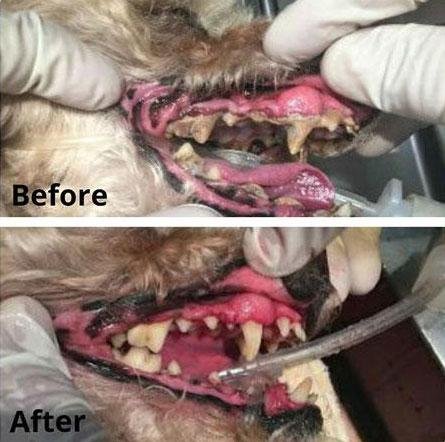
Veterinary dental care is the professional cleaning and assessment of a dog or cat’s mouth under general anaesthesia. It includes scaling to remove plaque and tartar above and below the gumline, polishing the enamel, a tooth-by-tooth oral exam, and full-mouth dental radiographs to assess the roots. Extractions are performed only when a tooth is beyond saving.
Why Dental Health Matters for Surrey Pets
Plaque forms within hours of eating and hardens into tartar, or calculus, within days. Once it sits below the gumline it causes gingivitis, and left alone that progresses to periodontal disease, which damages the structures holding the tooth in place.
The effects are not limited to the mouth. Ongoing oral infection places a burden on the body that can affect the heart, liver, and kidneys over time. This is one reason we look closely at the mouth during every wellness exam rather than waiting for an owner to raise it.
Signs Worth Booking an Appointment For in Surrey
Persistent bad breath, or halitosis, is the most common signal and the easiest to dismiss. Others include yellow or brown build-up along the gumline, red or bleeding gums, chewing on one side, dropping food, pawing at the mouth, or a sudden reluctance to let you near the face.
Cats in particular hide oral pain extremely well. A cat that has simply become quieter or fussier about food may be a sign of something going on in the mouth rather than ordinary ageing.
What a Dental Procedure Involves in Surrey
A proper dental cannot be done on an awake animal, because the parts that matter are below the gumline and behind the teeth.
Assessment and imaging
Once your pet is safely under general anaesthesia, we chart every tooth, probe the gingival pockets, and take full-mouth dental radiographs. Imaging is the part that changes outcomes, because roughly half of what matters in a pet’s mouth is not visible to the eye.
Scaling and polishing
We scale away plaque and tartar above and below the gumline, then polish the enamel. Polishing matters because scaling leaves microscopic grooves, and plaque takes hold in them far faster than on a smooth surface.
Extractions where needed
Where a tooth is beyond saving, usually through advanced periodontal disease or a root abscess, removing it relieves pain. Owners very often report their pet is brighter and eating more comfortably afterwards.
Anaesthesia Safety for Dental Work in Surrey
The most common reason owners delay a dental is anaesthesia, and the worry is reasonable. It is worth weighing against the alternative, because leaving an infected mouth untreated is itself a risk, and it is a daily one.
Before the day we examine your pet and recommend pre-anaesthetic bloodwork, which checks organ function and flags anything that would change our approach. The protocol is then matched to your pet’s age, weight, and health rather than applied from a standard dose. During the procedure a team member stays with your pet continuously, monitoring heart rate, breathing, blood pressure, oxygen saturation, and temperature, with intravenous fluids running and active warming in place.
Older animals are not automatically poor candidates. Age is not a disease, and many of our dental patients are seniors who go home the same evening and are noticeably more comfortable within days. Where we genuinely think the risk outweighs the benefit, we will say so.
Dental Disease in Cats in Surrey
Cats have dental problems that dogs largely do not, and they are easy to miss.
Tooth resorption
Resorptive lesions, where the structure of the tooth breaks down from the root outward, affect a large proportion of adult cats. They are painful and frequently invisible without radiographs, which is one of the clearest arguments for imaging every dental patient rather than only the obvious cases.
Stomatitis and gingivitis
Some cats develop severe inflammation of the gums and mouth that is out of proportion to the visible tartar. It makes eating genuinely painful, and affected cats often go quiet rather than obviously off their food.
If your cat has started eating more slowly, chewing on one side, preferring soft food, dropping kibble, or drooling, please have the mouth looked at. Owners regularly tell us afterwards that they had put the change down to the cat getting older.
Anaesthesia-Free Cleaning and What It Leaves Behind in Surrey
Scaling the visible surfaces of an awake animal’s teeth makes the mouth look better. It does not address what is happening below the gumline, and that is where periodontal disease lives.
Without anaesthesia it is not possible to probe the gum pockets, chart each tooth, take radiographs, or clean the inner surfaces properly, and a cosmetically clean mouth can hide advanced disease at the roots. It can also be stressful for the animal. We mention this because owners sometimes arrive believing a dental has already been done, and we would rather explain the difference than let the assumption stand.
Dental Care for Your Pet at Home in Surrey
Daily brushing is the mainstay of home dental care between appointments, and it is more achievable than people expect if introduced gradually. Dental chews and water additives can help, though they work alongside brushing rather than instead of it.
Ask us to show you the technique at your next visit. Two minutes with a demonstration saves a lot of frustration at home, and the usual mistake is starting with the brush rather than with the handling.
Build it up over a fortnight. Let your pet lick the paste off your finger for a few days, then touch the outer surfaces of the teeth with a finger, then introduce the brush for a few seconds at a time. Aim for the outer surfaces along the gumline, which is where plaque gathers, and stop while your pet is still happy. Families across Surrey, including Newton, manage this far more easily than they expect once the sequence is right.
Good to know
Questions Surrey Pet Owners Ask Us
Why does a dental cleaning require anaesthesia?
How often does my pet need a dental cleaning?
Are dental x-rays really necessary?
My dog's breath smells. Is that just normal dog breath?
Will my pet be able to eat after extractions?